B2B conference outreach case study
How Shivaami Booked 25 Meetings Around AI4 in ~30 Days
A three-day booth became a month-long demand campaign built around fast data, human-reviewed outreach, reply handling, booking follow-up and day-of coordination.
Client: Shivaami, enterprise IT solutions
25 meetings were booked. We tracked 18 prospect booth visits. Booked and attended are treated as different metrics.
The event app was a working outreach channel, not just a place to check the agenda.
Source: Shivaami campaign tracker, 1 July to 7 August 2026. “Booked” means a meeting entered in the campaign aggregate. It does not mean every meeting happened.
The audience quality
Who replied?
Based on 71 positive responders with structured role, company-size and geography data.
45 of 71 held Director, VP, Head or C-suite roles.
47 of 71 worked at companies with at least 1,000 employees.
49 were US-based. 55 were in North America.
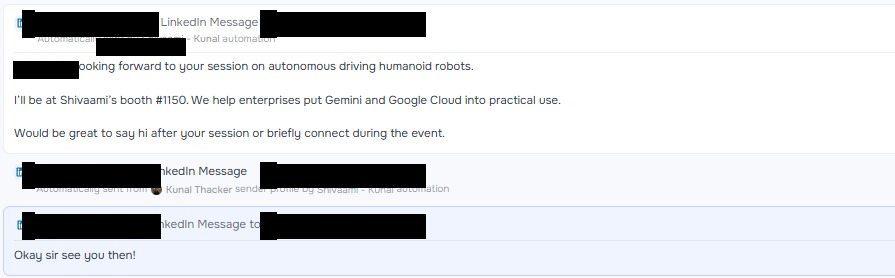
One anonymized journey
What one successful conversation looked like
A generic booth invitation was not enough. The conversation became more specific when the message gave the prospect a concrete reason to engage.
- 1Cold messageEvent context and a relevant enterprise AI angle.
- 2ROI ChallengeA concrete booth activity replaced a vague “let’s connect.”
- 3Value reframeCould the pilot stay useful after integration, governance and adoption costs?
- 4Positive replyA simple “Yes” moved the record into reply handling.
- 5Calendar conversionThe team asked permission to send a tentative placeholder.
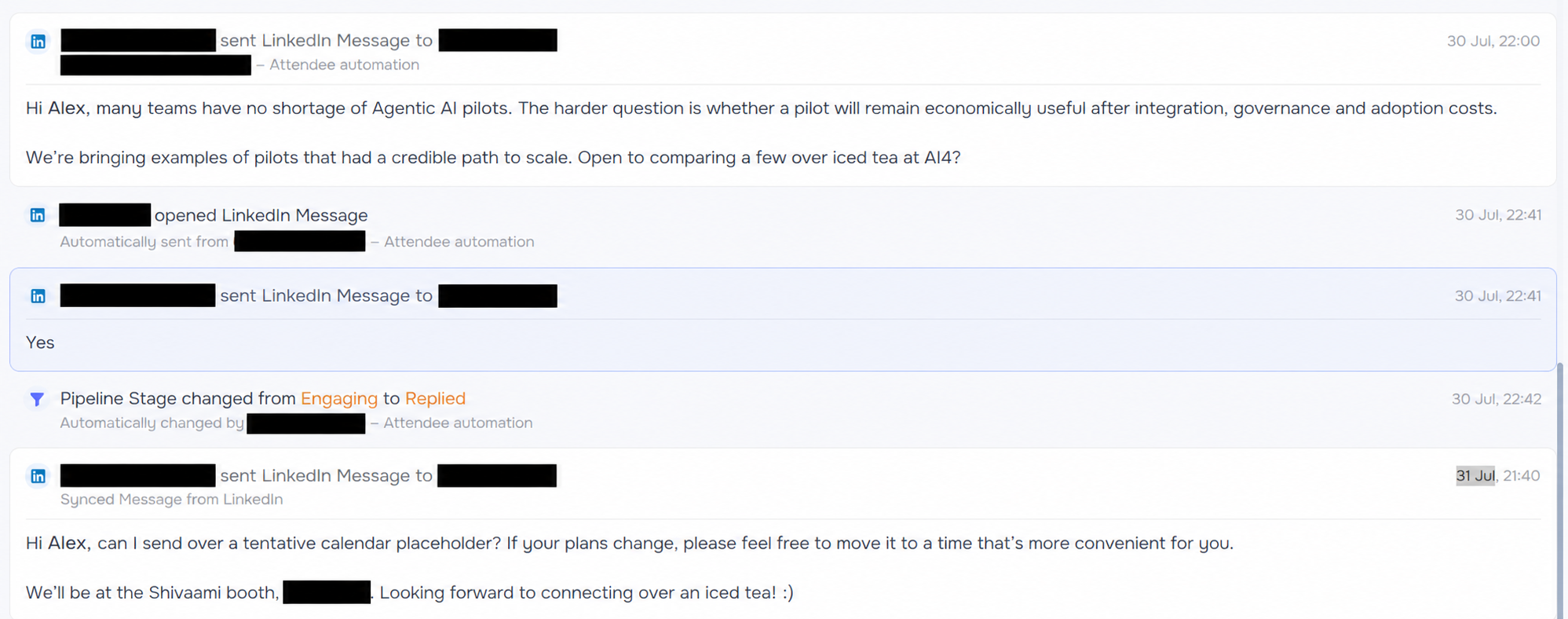
LinkedIn outreach snapshot
How LinkedIn created one major stream of replies
The campaign needed more than one good message. Each stage created the next piece of work, while the AI4 app ran as a separate outreach and booking lane.
The snapshot combines LinkedIn campaign-level milestones. It is directional rather than a person-by-person cohort funnel. AI4 app outreach, InMail and email are reported separately.
Channel performance
The event context worked. Email barely moved.
| Channel | Attempts / leads | Accepted / sent | Replies | Positive | Key rate |
|---|---|---|---|---|---|
| Speakers | 885 | 286 | 53 | 40 | 32.3% accepted 18.5% response |
| Attendees | 1,023 | 221 | 38 | 30 | 21.6% accepted 17.2% response |
| AI4 accounts (LinkedIn) | 1,242 | 264 | 21 | 15 | 21.3% accepted 8.0% response |
| InMail | 114 | 69 sent | 1 | 0 | 1.4% response |
| 817 leads | 4,103 emails | 2 | 0 | 58.5% open 0.24% reply |
Connection requests and messages sent in the app, based on the campaign team’s operating estimate.
17 of 71 structured positive leads were tagged to an AI4 app source in column N.
12 of 25 booked meetings used the AI4 app as the source. The other 13 used a calendar link.
The 17 app-attributed positive leads are part of the 71-record structured responder dataset. They should not be added to the 85 campaign-level positive-reply aggregate.
How the app lane worked
Browser-assisted, human-sent
For prospects who had not replied on LinkedIn or email, the team reused the same researched angle in the AI4 app. Clay produced the personalized message asset. A Codex-built browser helper loaded the selected draft into the app, then a dedicated account operator checked the recipient, context and copy before manually sending it.
The workflow is supported by private Clay output, AI4 app compose views, reply threads and meeting records. Raw operating screenshots remain private because they contain prospect and account data.
- 01Personalize in ClayBuild the prospect-specific angle and channel-ready draft.
- 02Select the no-reply laneUse the app after no useful LinkedIn or email response.
- 03Prefill with CodexLoad the approved draft into the browser compose field.
- 04Human review and sendVerify the person, context and message before clicking send.
- 05Track the outcomeLog replies, qualification, bookings and booth coordination.
Event context created timing
People knew why the message arrived now and where the conversation could happen.
LinkedIn made identity visible
The sender, event and prospect context sat in one familiar place. Replying took less effort.
The offer became specific
The ROI Challenge and iced-tea conversation gave the prospect a small, concrete reason to stop.
The email result stays in this case study for a reason: 4,103 emails produced two replies. Opens were healthy. Conversation was missing. The team monitored sender and channel performance, then shifted effort toward the channels producing real responses.
The offer
The Agentic AI ROI Challenge
Prospects could bring an AI use case or choose one from a prepared list. The booth team would estimate its ROI, add it to a leaderboard and discuss whether it had a credible path to production.
- Small enough to understand in one message
- Relevant to an AI-heavy event
- Useful even before a sales conversation
- Easy to continue at the booth
“The harder question is whether a pilot will remain economically useful after integration, governance and adoption costs.”
Day-of operations
Before, during and after had different jobs
Create planned conversations
Build the list, personalize, qualify replies, chase booking and send reminders.
Turn intent into arrival
Confirm location, coordinate handoffs, watch timing and track who reached the booth.
Follow up by outcome
Separate attended, missed, warm walk-in and still-interested prospects before follow-up.
Attendance tracking mattered because a booked meeting and a completed booth conversation are different outcomes.
What prospects actually said
Real replies from the campaign
Names, exact titles and direct identifiers have been removed. Firmographic captions use employee bands and company context recorded in the campaign tracker.
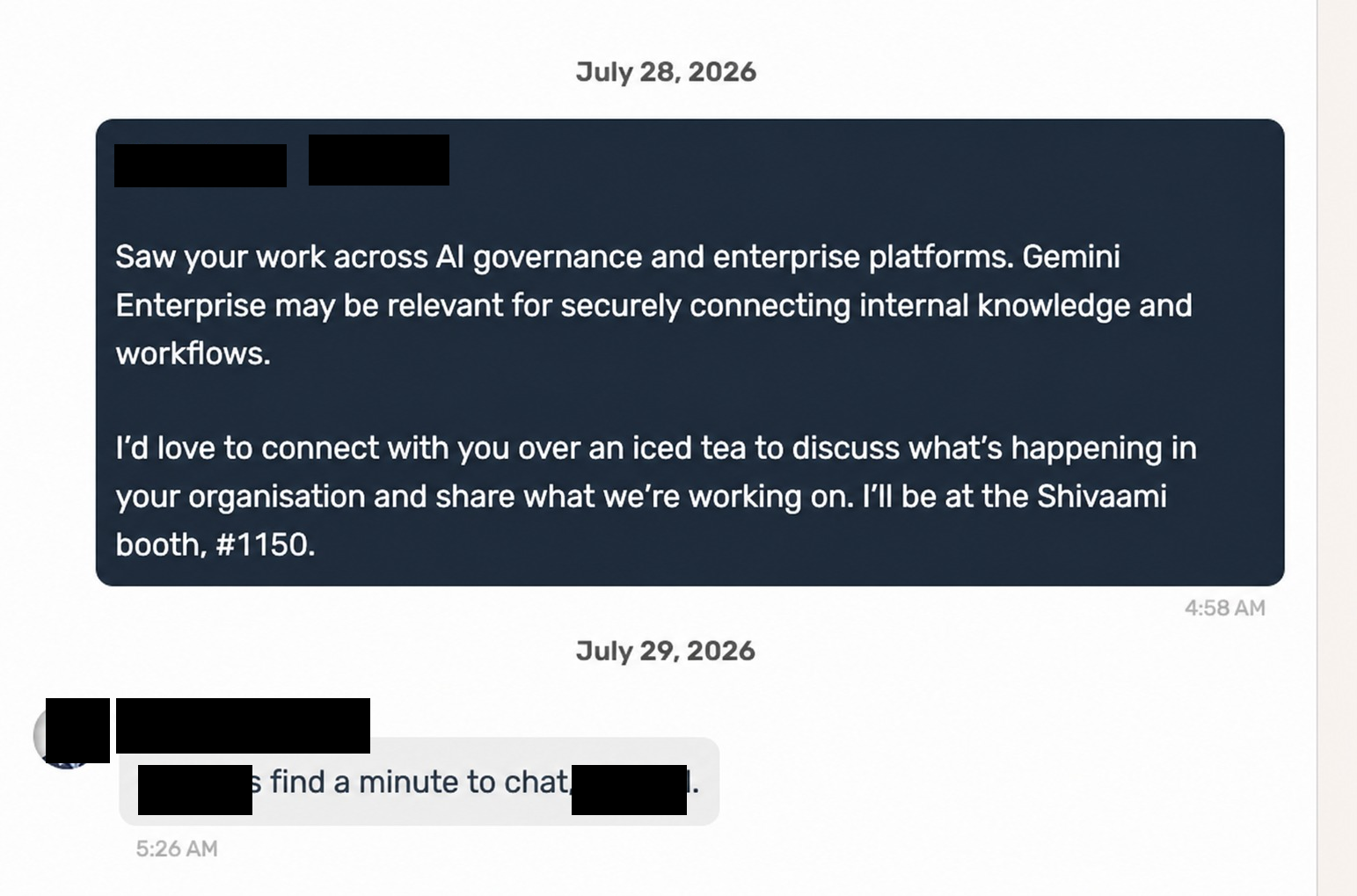
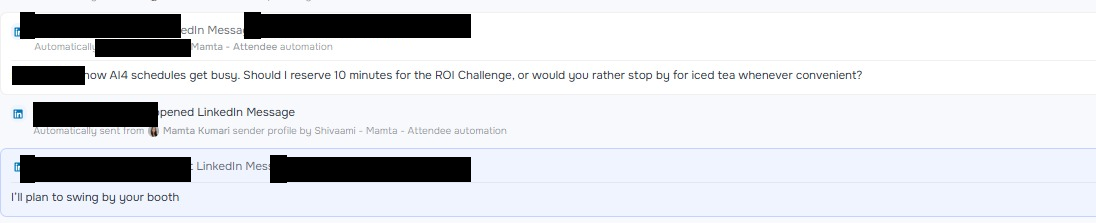
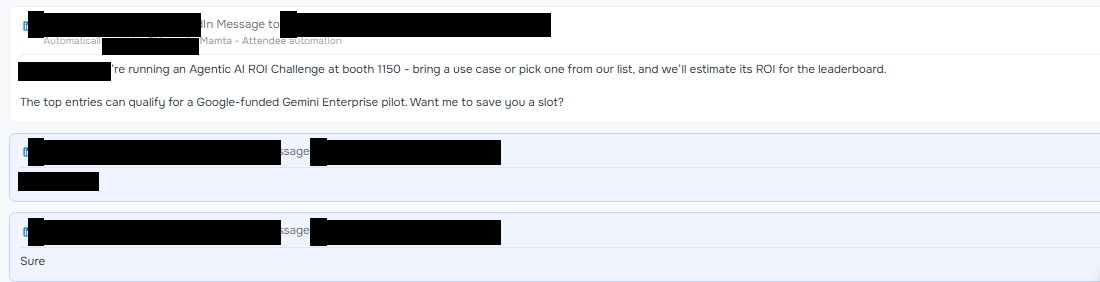
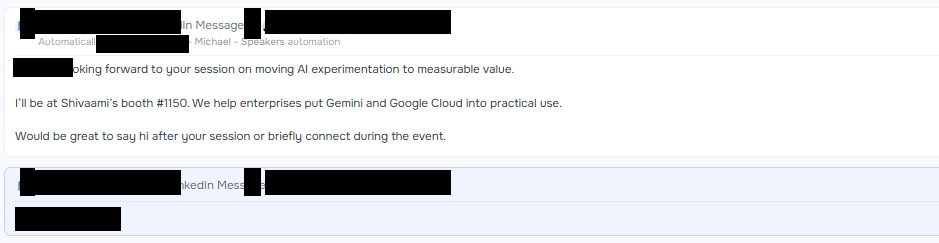
These are original platform screenshots with irreversible pixel redactions. No exact name, title, profile link or contact detail is published.
The operating system
The hard part was closing the loop fast enough
Every reply created a decision, an owner and a next action. The campaign stayed useful because the team moved quickly.
- 01Build audience
- 02Enrich & qualify
- 03Personalize & QA
- 04Multichannel outreach
- 05Book & chase
- 06Post-event follow-up
See the full 12-step operating workflow
- 01Event data + scrapeSpeakers, attendees, accounts and event-app signals
- 02Clay enrichmentCompany, role, size, geography and contact context
- 03Priority A / B / SkipFocus effort where fit and access were strongest
- 04AI-assisted personalizationDraft a relevant angle from verified evidence
- 05Human QACheck truth, tone, privacy and the meeting ask
- 06Multi-channel launchLinkedIn, AI4 app and email support
- 07Reply identificationFind real interest quickly and monitor channel yield
- 08Reply qualificationSeparate curiosity, warm intent and booking readiness
- 09Booking chaseTurn “sounds good” into a specific next step
- 10Schedule + remindCalendar or event-app slot, then timely reminders
- 11Coordinate + trackDay-of handoffs, booth arrival and attendance status
- 12Segmented follow-upDifferent follow-up for attended, missed and warm visits
Sender and channel performance were monitored throughout. When one lane produced stronger replies, the team shifted effort toward it.
Methodology and evidence
What existed behind the campaign
This was a live operating system with evidence, decision gates and human owners. The Clay table was one part of that system. It organized event context, research, qualification, drafts and conditional handoffs.
Source: Clay working-table QA export, 12 August 2026. These figures describe the operating table at export time. They do not mean 3,745 people were contacted, enriched or sent a message.
Research before qualification
The evidence stage checked identity, current role, location, company scale and meaningful market presence. Its job was to gather facts. A separate stage made the Priority A, Priority B or Skip decision.
Different copy for different contexts
Verified evidence fed fit reasoning, template selection and separate drafts for cold email and the AI4 event context. Humans checked the output before outreach.
Conditional work, not blanket enrichment
Email discovery and verification ran only when prior conditions were met. This reduced unnecessary processing and kept weak or incomplete rows from moving automatically. Clay documents this pattern as conditional runs.
Claim register
| Public claim | Evidence used | Definition or limit |
|---|---|---|
| 25 meetings booked | Campaign aggregate | A meeting entered in the tracker. It is not a completed-meeting count. |
| 85 positive replies | Campaign outreach aggregate | Positive replies across the tracked event-outreach groups. |
| 71-person responder profile | Row-level firmographic subset | The denominator for seniority, company-size and geography percentages. |
| 18 tracked booth visits | Attendance tracker | 12 scheduled prospects plus six additional warm visitors. |
| 17 app-attributed positive leads | Interested Leads, column N | 24% of the 71-record structured positive-lead subset. |
| 12 app-sourced bookings | Meeting-source aggregate | 48% of the 25 booked meetings. The other 13 used a calendar link. |
| ~3,000 AI4 app attempts | Campaign-team estimate | Approximate connection requests and messages. It is not a reconciled tracker count. |
| Human-sent app outreach | Private workflow and message captures | The browser helper prefilled drafts. A dedicated operator reviewed and manually sent each message. |
| 3,745 working records | Clay QA export | Table size at export time. It is not a send-volume claim. |
What we disclose
Campaign definitions, aggregate results, major tools, workflow stages, decision gates, channel performance and limitations.
What remains proprietary
Exact prompts, scoring thresholds, deliverability rules, message-assembly logic and sender-routing logic. These are proprietary operating IP.
What we learned
What we would keep and what we would change
Keep
- Event context before product explanation
- One concrete booth offer
- AI assistance followed by human QA
- Fast reply ownership and booking follow-up
- Booked and attended tracked separately
Change
- Ask for the calendar slot earlier after clear intent
- Use email mainly as support when LinkedIn is working
- Separate tentative, confirmed and visited statuses every day
- Plan more day-of reminders for prospects who say “I’ll stop by”
- Start the highest-priority accounts first, then expand
Your next conference
Pressure-test the meeting plan before buying more booth traffic.
If you're exhibiting at a B2B conference in the next 6–12 weeks, send us the event name. We'll tell you whether outbound around it is worth doing.
Send BizAmps the event name